Standard
An Acceptable Future: Freedom, Human Dignity and a Healthy Civilisation
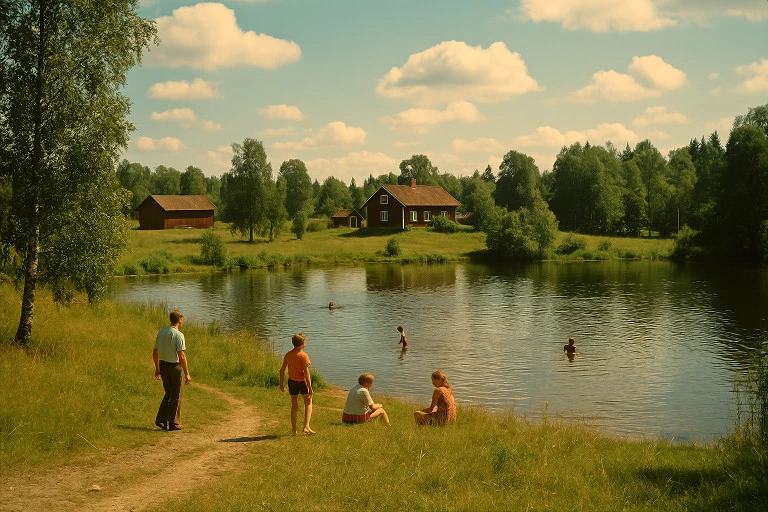
An acceptable future is not an Orwellian future.
A truly good life cannot exist without freedom, dignity, and the ability to think, create, love, and choose our own path. The greatest danger of the future is not only disease, poverty, or death — it is the possibility of a society where human beings are controlled, and worst of all, reduced to creatures whose potential is destroyed.
Indeed, the lesson of dystopian visions such as George Orwell's Nineteen Eighty-Four, and others, is not that technology itself is the enemy. Technology is merely a tool; to exert power over others, high-tech is not even required. Just a rotten mind.
Therefore, a healthy civilisation must protect privacy, individuality, curiosity, and human agency. Progress without wisdom can become a prison. Progress guided by compassion can become liberation.
A Good Life: Health, Peace and Human Flourishing
Throughout most of human history, this pursuit of a good life was not a philosophical abstraction — it was a daily practice. The ancient Greeks called it eudaimonia: flourishing. Not mere pleasure, nor the absence of pain, but a life fully and wisely lived.
This timeless ideal is perfectly captured by the Stoic philosopher Epictetus:
"He is a wise man who does not grieve for the things which he has not, but rejoices for those which he has."
The core insight behind this wisdom is that much of our suffering comes not from circumstances, but from our relationship to them. Health, peace, clarity, and love — these are not prizes to be won at the end. They are practices, cultivated daily.
Health — the Foundation
Beyond the mere absence of illness lies something far richer: vitality. This is the ability to move through the world with energy, with presence, and without the constant noise of a body in distress. Crucially, modern research now converges with ancient wisdom on the very same fundamentals — movement, sleep, real food, sunlight, and connection.
Such a lifestyle is not complicated; it is simply difficult because it demands consistency over intensity. After all, a body cared for daily becomes a fundamentally different instrument than one that is neglected and then frantically restored.
Peace — the Inner Climate
True peace begins with mindfulness, which is not a mere technique — it is a disposition. It represents the capacity to be where you are, rather than perpetually elsewhere in thought. Most dissatisfaction is either retrospective or anticipatory; yet the present moment, when examined honestly, is usually bearable — and often far more than that.
Practices such as meditation, time in nature, deliberate solitude, and deep conversation are therefore not luxuries. They are essential maintenance for a mind that the modern world endlessly fragments.
Furthermore, the longest-running studies on human well-being converge on a single, vital finding: the quality of your relationships is the strongest predictor of how well and how long you live. Not wealth, not fame, and not achievement — but connection.
This insight is not sentiment; it is biology. We are inherently a social species, wired for belonging. Loneliness is as physically damaging as smoking, whereas deep friendship is protective in ways that medicine simply cannot match.
Living Well Within the Finite
The classical path accepts the limits of human existence — not because those limits are necessarily desirable, but because they are the reality we have inherited. It makes peace with this condition — and finds that this acceptance, paradoxically, makes life richer. When time is limited, presence becomes urgent; when nothing lasts, beauty becomes truly precious.
Ultimately, the goal is to live fully and well, while it lasts.
If this path resonates, explore it, practise it, and share it. This is no small thing; indeed, for most people, on most days, it is everything. However, if this is not enough, please continue reading.